
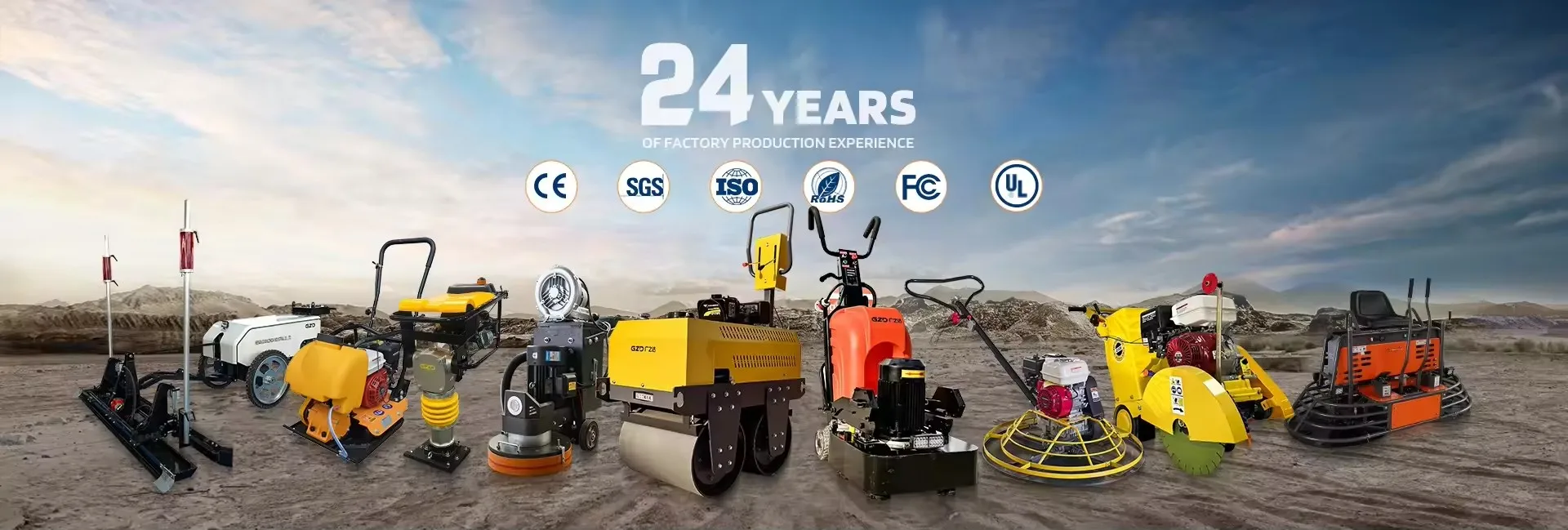
I have worked in the global construction machinery industry for fifteen years, handling the export business of over a thousand gasoline impact tampers. Whenever a client asks me "Which gasoline impact tammer should I choose?", I always start by understanding their specific needs. Today, I would like to share a proven selection methodology.
The first thing to consider is the project scale. For small-scale courtyard hardening and sidewalk repair jobs, I recommend using lightweight models with an impact force of 8-10 kN. These devices typically weigh between 50-70 kg and can be moved and operated by a single person. I remember in the temple courtyard restoration project in Kyoto, Japan in 2019, the client needed to reinforce the foundation without damaging the original stone path. The 65 kg gasoline impact tammer I provided perfectly solved the problem - sufficient impact force to complete the tamping without causing vibration effects to the surrounding structure.
Soil type determines the technical parameters. In sandy soil areas, such as certain regions in the Middle East, I recommend choosing high-frequency models. I have specially developed models with 700-750 impacts per minute for this type of market, allowing the sand particles to reach the optimal compactness through rapid and continuous impacts. On the contrary, in clay soil areas, such as the red soil belt in Southeast Asia, I recommend models with a larger impact stroke, with a single impact force of over 12 kN, which can effectively break up soil clumps.
Altitude is a key factor that many people overlook. In the project in Cusco, Peru (at an altitude of 3,400 meters) last year, the client reported that the ordinary gasoline impact tammer was severely underpowered. I immediately adjusted the main fuel supply hole and idle fuel supply hole of the carburetor, reducing the fuel supply and increasing the air intake of the air filter. After recalibration, the equipment restored 90% of the power at sea level. Now all the models exported to high-altitude areas are equipped with an altitude carburetor kit.
Environmental requirements determine the configuration choice. For municipal projects that require night construction near residential areas, I developed a low-noise version. By optimizing the internal structure of the muffler and adding a soundproof cover, I reduced the operating noise from 102 decibels to 92 decibels. Although the cost increased by 15%, in the municipal project in Hamburg, Germany, this improvement granted the client permission for night construction and shortened the project duration by 30%.
Fuel availability affects equipment selection. In some remote areas in Africa, 90-grade gasoline is the only available fuel. I specially designed engines for these markets that are resistant to low-grade fuel, strengthening the anti-strengthening performance of the valves and pistons. At the same time, I suggested that the client add a fuel stabilizer to prevent the gasoline from gumming up during storage.
Finally, maintenance convenience is a factor to consider. For areas lacking professional maintenance personnel, I recommend using simple wind-cooled two-stroke models. Although the fuel consumption is slightly higher, the maintenance is extremely simple and the failure rate is low. While the four-stroke models provided for professional contractors are equipped with an oil alarm system and easy maintenance design, all maintenance points are within reach.
The real professional selection is not recommending the most expensive equipment, but matching the most suitable solution. Every project I handle will establish a detailed file, recording the equipment performance and operating data. These valuable first-hand materials allow me to provide precise selection suggestions to global customers.


